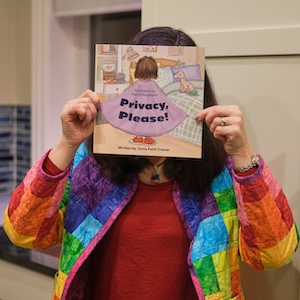
This guide is designed for parents, teachers, and other caregivers to gain insights and start discussions with young children.
Spot examples
Ask children to look for characters in the book who protect their privacy--or who might be invading someone else's.
On most pages of the book you might ask questions about characters protecting their privacy like: Who is protecting their privacy here? What are they doing to protect their privacy? Why do you think they want to protect their privacy? How do you think they are feeling right now? Do you ever [action character is taking to protect their privacy] to protect your privacy? Adults might talk about actions they take to protect their privacy, especially those that would be appropriate for the child to mimic.
On pages depicting privacy invasions, you might ask: Who is invading someone's privacy here? Who is having their privacy invaded? How do you think [the character having their privacy invaded] feels right now? Has anything like this ever happened to you? Adults might talk about situations where children invade their privacy and how it makes them feel.
Talk about feelings
How does it feel when someone comes into your space without asking? How does privacy help you feel calm or safe? Adults may talk about their feelings too, using examples relatable to children.
Practice asking for privacy
Talk about ways you can ask an adult or another child to let you have some privacy. You can offer some scenarios, for example: "Let's pretend you are tired of talking to people and you just want to be by yourself for a little while. What could you say to me [or another adult] to ask for privacy?" Or: "Let's pretend you are playing by yourself and [another child, maybe a sibling] comes and sits down next to you and you don't feel like playing with them right now. What could you say to them?"
Explore reasons for privacy
Talk about times when we might keep things private--like enjoying a surprise, sharing a secret with a friend, or having time alone to think. Ask children to talk about a time when they did each of these things. Adults may provide examples as well.
Find balance
Sometimes it feels good to share our thoughts or open our doors. How do we decide when we're ready? Ask children for examples of when they transitioned from their private place into a more public place. For example, if the child has already talked about going into a space to be alone, you could ask, "After you have been in [private place] for a while, how do you decide you are ready to come out?" For a child who likes to create art or practice skills without people watching, ask a question like, "How do you decide you are ready to show us your pictures [or demonstrate a particular skill]?"
Create privacy together
Even if young children can't close doors for safety reasons, they can still find small ways to have privacy--like sitting in a quiet reading nook, listening to music with headphones, or taking a few deep breaths alone. Think about ways to help children create private spaces in your environment and discuss which options they might like to try next time they want to have some privacy.
Draw a picture
I've collected hundreds of pictures after giving people the prompt: "What does privacy mean to you? Draw a picture." You can see my collection at. You can use this prompt with young children, or try one of these prompts:
Make a door hanger
Children can make door hangers like the door hangers you find in hotels to indicate when they want privacy and when they want to play.p. 3-5
 I introduce the concept of privacy to young children as simply
wanting to be alone and not wanting to be seen, heard, or touched. I
suggest something a child can say to request privacy ("I want to be
alone now. Can I have some privacy, please!"), and offer some ways
to have privacy (going to their room, reading a book, listening to
music on headphones, hiding under a blanket, closing the
blinds). You can point out to children what the child in the book is
doing to gain privacy. You can also ask them how they feel when they
want privacy and in what ways they feel different when they are able
to have some privacy. Talk about using private spaces as a way to
calm down or release negative emotions. Ask children to practice
asking for privacy.
I introduce the concept of privacy to young children as simply
wanting to be alone and not wanting to be seen, heard, or touched. I
suggest something a child can say to request privacy ("I want to be
alone now. Can I have some privacy, please!"), and offer some ways
to have privacy (going to their room, reading a book, listening to
music on headphones, hiding under a blanket, closing the
blinds). You can point out to children what the child in the book is
doing to gain privacy. You can also ask them how they feel when they
want privacy and in what ways they feel different when they are able
to have some privacy. Talk about using private spaces as a way to
calm down or release negative emotions. Ask children to practice
asking for privacy.
Caregivers can talk about appropriate ways to request privacy and places a child can go in their home or school to have privacy. Not all children have their own bedrooms, and at school, it might not be possible for a child to leave the classroom. However, adults can help identify privacy zones within their spaces: for example, a privacy corner, a privacy chair, or a table that a child can sit under. A blanket, scarf, hoodie, or cape may serve as a barrier between a child and other people in the room. Children may be able to create more of a feeling of being alone by facing a wall with their back to other people or putting on headphones. Adults may be able to help a child preserve their privacy by staying nearby but keeping their back turned so the child does not feel like they are being constantly watched.
p. 6
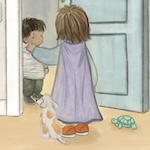 Siblings are often seen as the greatest privacy invaders by
children who have them. However, children may experience similar
invasions in settings with unrelated kids who may intrude on their
play space, for example, at school or at a playground. This page
acknowledges the frustrating feeling of having one’s space invaded
and suggests appropriate ways to handle this. Adults may talk about
boundaries and suggest other ways for children to handle unwanted
intrusions on personal space in their setting. This is also a good
opportunity for discussing how other children or adults may feel
when a child invades their privacy, and help children understand why
they should show respect for other people’s desires for privacy and
personal space.
Siblings are often seen as the greatest privacy invaders by
children who have them. However, children may experience similar
invasions in settings with unrelated kids who may intrude on their
play space, for example, at school or at a playground. This page
acknowledges the frustrating feeling of having one’s space invaded
and suggests appropriate ways to handle this. Adults may talk about
boundaries and suggest other ways for children to handle unwanted
intrusions on personal space in their setting. This is also a good
opportunity for discussing how other children or adults may feel
when a child invades their privacy, and help children understand why
they should show respect for other people’s desires for privacy and
personal space.
p. 7-8, 11
These pages introduce the idea that we can have privacy together with another person. First, the child invites their friend into their private space and shares secrets with their friend. Similarly, on page 11, the child talks to a teacher at school in private, away from other children. Caregivers might ask children to talk about who the special people are in their lives that they like to share fun secrets with (special songs, silly jokes, secret password to the clubhouse, etc.), as well as what they can do when they want to talk to an adult without other people hearing the conversation.
p. 9-10
These pages acknowledge that even when we enjoy playing with our friends, sometimes we need a break to be alone. Adults can offer examples about what they do when they need to take a break from other people, and ask children to talk about what they like to do when they take a break. You can also talk about giving friends space and respecting their desire to play by themselves sometimes.
p. 12-13
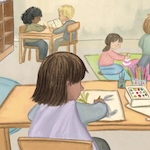
These pages depict the need people may have for privacy during creative endeavors. It is natural for people not to want to share their first drafts with others or to let people watch them when they are learning a new skill. Some people don't mind others watching them as they create or practice, but other people feel self-conscious and have trouble being creative or practicing while being watched. In the classroom, children are generally encouraged to share and talk about their creative work. Here, we acknowledge that some children (and adults) may want time to create privately and may want to choose when they are ready to share. Adults can discuss how children can gain some privacy for creative endeavors within the space of their school or home environment, as well as why it is fun to share our creations when we are ready.
p. 14-17
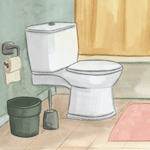
These pages focus on bodily privacy. While a lot more could be said about bodily autonomy, I only address issues in this book related to bathrooms and changing clothes. This is a bit tricky with this age group, as four-year-olds may not yet mind if other people see their bodies, and they may be used to changing or going to the bathroom in front of adults. Six-year-olds, on the other hand, are more likely to want privacy in the bathroom and while changing.
The discussion here may be different depending on the age of the children in the audience and whether the discussion is happening at home or at school. Pre-school bathrooms often do not have doors, and generally, adults are required to be present with children when they go to the bathroom at school. Teachers may want to talk about practices at their school, such as turning around when a child is on the toilet unless the child requests assistance. At home, caregivers might want to talk about closing bathroom doors. In addition, they may want to talk about giving adults privacy in the bathroom. The discussion might also include changing into bathing suits at the pool or beach, and trying on clothes in stores if these activities are relevant.
I've discovered that bathrooms are a great way to discuss privacy with both children and adults. In fact, I use bathroom examples extensively in my college and executive education courses! Check out my potty page to learn more.
p. 18-19
These pages introduce the idea that privacy can actually be fun. The child in the book puts on a fun costume with a disguise. Adults may talk about other ways that privacy can be fun. For example, adults may wrap presents without kids watching so that children will be surprised when they unwrap their gifts. Adults can talk about how much fun it is to be surprised.
p. 20-23
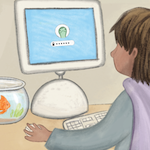
These pages discuss online privacy. This book is targeted at 4-to-6-year-olds, who are likely not spending a lot of time online yet. Chances are they will be spending more time online within a couple of years, so it is useful to start discussing basic online privacy issues. Here, we introduce the concepts of lock screens and passwords, as well as not sharing personal information online. Adults should tailor this discussion based on the type of online access children have at home or school and introduce other age-appropriate online safety concepts.
I also address the idea that children should have agency to decide when they want their photos taken. This is a little bit tricky as there are many situations in our modern world when we have little or no choice about having our photos taken. In addition, school picture days and family group photos may not be easy for a child to opt out of. An avid photographer myself, I am sometimes conflicted between wanting to take my kids' photos and respecting their desire not to have their photos taken. My recommendation is to explain to children that there are times when we have to have our photo taken, for example, adults have to get their photos taken for their driver's licenses if they want to drive a car. There are also times when we might not really want to have our photos taken, but we do it to make our family or friends happy -- for example, a big family photo at a holiday dinner or a class photo at school. But there are other times when a photo is entirely optional. Adults might explain why they want to take a photo (e.g., "Grandma would love to see how you look all dressed up," or "Your parents would like to see the project you are working on at school today") and offer opportunities for children to choose when they are ready for a photo and what is included (e.g., "Would you rather take the photo after lunch?" or "Would you like to show off your painting in the photo instead of your playdough?" or "Where would you like to stand for this photo?"). But adults should respect a child's desire not to be photographed or their requests that the photo not be shared. You might ask the child who it is ok to share the photo with or let them look at the photo and then decide.
A lot has been written about sharing content related to children on social media. When parents do this, it is sometimes called sharenting. There are many opinions about what threat this poses and whether it is ever safe. My advice is to know the audience for anything you share online about your children. The safest way to share is to send photos directly to the people you want to see them (e.g., via email or text message). You could also put photos and videos in an online album and share the album with specific family and friends -- but make sure you have not accidentally made your album public. If you choose to share photos of children on social media, make sure you do not share them publicly. On Facebook, for example, share only with friends, and make sure your friends list is limited to people you actually know. You should also avoid sharing photos of other people's children without permission, and you may need to crop them out of group photos. Also, be aware that even if a child's face is not in the photo or has been covered with a sticker or emoji, there may be other things in the photo that could identify the child (house number, license plates, the child's coat and backpack, etc.) so you may still want to limit sharing to people you know personally.
p. 24
This page reminds us to take a break from technology and find privacy outside. Adults might talk to children about where they can find privacy outside. In this picture, the child is playing in a fenced-in backyard. A family that goes on hikes in the woods or canoeing on a lake might talk about privacy in natural environments. While this book is not focused on limiting screen time, this is a good opportunity to bring that up too.
p. 25-27
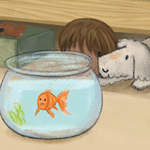
These pages discuss privacy from the perspective of animals and then ask the child to reflect on what they do when they want privacy. Asking children where animals find privacy is a good way to stimulate discussion. You can talk about family or classroom pets, animals at the zoo, or animals in the wild. Some animals find places to hide, some climb trees or fly, some dig holes and burrow, and some use their shells for protection or their coloring as camouflage to blend into their environment. Pet goldfish have more difficulty hiding than many other animals because they live in a glass bowl. But children may point to rocks or plants in the bowl that can afford the goldfish some privacy. Adults can also ask how the goldfish might feel about not having much privacy.
The final page is a natural place for discussion of the question: "What do you do when you want privacy?" This might be accompanied by a drawing activity.